Tutorials & Guides
Inventory Tracking: A Complete Guide for Growing Businesses
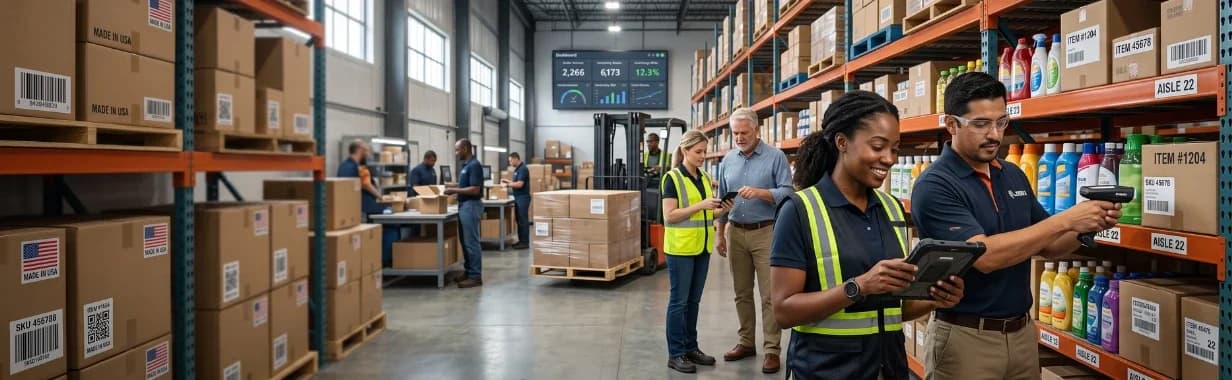
No retailer in the world has an exact idea about their inventory stored in the warehouse. Although they must have an approximate visibility but not the accurate count in hand. For individual shopkeepers who are handling multiple tasks at a time like store locations, sales funnel, supply chain, and distributor connections have difficulty in maintaining balance. It ultimately results in loss of sales, high inventory expenditure, and unhappy clients.
Here comes the role of inventory tracking that guides retailers about their own inventory in proper specifications like what is in stock, where it is located, date of reorder, etc. Hence you can optimize strategy for manual inventory rather than simply relying on guessing games.
WHAT IS INVENTORY TRACKING?
Automated Inventory tracking system for small business helps to supervise and handle the stock throughout the operations. It helps you know the count, location, movement and expiry date of the stock. Without proper knowledge of your inventory, you must be relying on past data or simply estimates.
Retailers must indulge in inventory tracking process to:
- Avoid losing sales due to stockouts
- Smoothen the supply chain management
- Substitute speculations with exact data
- Spot any shortage or theft immediately
- Customer retention by maintaining stocks in advance
STEP-BY-STEP GUIDE OF INVENTORY TRACKING PROCESS
Here is a step-by-step guide to monitor your inventory to avoid uncertain and unpleasant circumstances like annoyed clients, stock shortage, loss of items, no record of stock, etc. Get an insightful plan on how to keep track of inventory and retail business management.
-Step 1: Acquiring & Recording Stocks
It all begins with the arrival of products & stock at your door step. At this starting stage of inventory tracking process needs:
- Examining for any product quality or damage problems
- Logging each item into the inventory management system
- Cross-checking & confirming all products as per buy order
- Building & surveying any distinctive labels/tags
Once this foundational step is set accurately, there will be no scope for any errors and unnecessary pain points.
-Step 2: Assortment & Warehouse Outlining
After all the goods are collected, they must be kept at safe warehouses. Under this step, following parameters must be met:
- Allotting unique inventory spaces
- Formulating a simple traversable structure
- Categorizing alike goods in unison
- Archiving all the locations in online system
Current inventory infrastructure involves mapping attributes that save the time on locating the goods. Product labels help you quickly identify the goods even without deep digging and opening the boxes.
-Step 3: Monitoring Stock Motion & Use
As you know, stocks are not bought to just keep at one place forever, they will move and never stay still. With goods transportation from one place to another as per the requirements, the inventory system must take note of the following:
- Parts & elements used in the production
- Examination of any goods returns
- Inter-department relocation of goods
- Alloting certain goods to specific users
Various basic inventory management systems also struggle to match with the dynamics. Hence, automated inventory tracking solutions master at handling records when the stock is constantly in motion anywhere to anywhere.
-Step 4: Order Execution Procedure
When the final order of products and items finally reach, in that time the stock monitoring procedure must take care of the below points:
- Revising the stock figures in real time
- Keeping track of any incomplete consignment
- Discovering precisely where the required goods are kept
- Making effective collecting routemaps
The efficacy of the stock monitoring procedure directly depends upon how speedily and correctly the orders are met. Businesses that excel at this step earn a crucial advantage with cheaper order execution costs and improved user experiences.
-Step 5: Routine Assessment & Settlement
Even after following all the steps religiously, it is not wise to move ahead without proper verification and reconciliation. The most exceptional & outstanding inventory tracking procedures also needs:
- Regular manual inventory checking at certain time frames
- Modifying the inventory monitoring program as per the needs
- Frequent spot assessing of particular portions
- Complete scrutiny of any noticeable difference
Perfect and comprehensive inspections can only keep the inventory tracking process on track with real-time fair results. It ensures that the system corresponds with what is showcased to the end user.
BENEFITS OF INVENTORY TRACKING SYSTEM FOR SMALL BUSINESS
-
Informed Decision Making:
Although route planning in logistics has been discussed for decades, technology now makes it easier to optimize supply chain operations. An AI-powered CRM can also connect customer and sales data with route planning, helping teams plan visits more efficiently. And indeed, the data-driven approach allows the owners to make well-informed and carefully analysed decisions.
-
Reduced costs:
Spoilage and wastage of inventory can be reduced if their expiration date are tracked throughout. It helps businesses create and modify their sales strategies, making the most of their available stock of goods. It enhances effectiveness of stock repurposing and reduces the risk of shortage or spoilage, thereby lowering the carrying costs.
-
Improved Customer Satisfaction:
Tracking inventory provides real-time visibility into available stock, pending stock, excess stock, and required stock. Business owners can set a minimum quantity threshold for different products to ensure they are ready to serve consumers at all levels of demand. This articulation helps reduce the impact of delayed deliveries and even cancellations.
-
Development of Quick Response Systems:
Inventory can be tracked in manual, automated, or hybrid mode. Tracking systems are now equipped with advanced automation to enable quick responses at all times. If the stock level falls below the permissible limits, the system can automatically trigger reorder alerts.
AI CRM software can also analyze historical sales patterns and customer demand to identify potential stock shortages early, allowing businesses to respond before they affect order fulfillment. The quick response systems keep the business afloat.
HOW TRADEONE IMPROVES INVENTORY TRACKING PROCESS?
Want to revolutionize inventory tracking system for small business? The TradeOne CRM solution provides adaptable and client-friendly forums devised for enterprises of all scales. Our strategy is an amalgamation of robust execution and advanced technology to supply highly durable and speedy success.
Our modern automated inventory tracking infrastructure is continuously upgraded with technologies such as the Internet of Things, Machine Learning, and Artificial Intelligence. TradeOne's AI-driven CRM capabilities can help businesses connect sales, customer, and inventory data, making it easier to identify demand patterns and plan inventory requirements. Hence, our TradeOne CRM inventory management system becomes your powerful tool to manage stocks.
Contact us for a free trial. Our considerate tactics lets you save time, effort and money with happy clients and market reach.
FREQUENTLY ASKED QUESTIONS
1. How to keep track of inventory?
Keeping track of inventory can be done in both manual as well as automated manner. It involves various methods that depend upon various factors like organizational goals, financial restraints, business’s complexity, stock challenges, and growth phase.
2. What are the different methods for inventory tracking?
Inventory tracking methods vary as per the business products and stock quantity to maintain. Some of the methods to consider are card system, accounting methods, Open source solutions, cloud-induced software, third-party distributors, manual tracking, spreadsheets, inventory management system, SaaS and inhouse solutions.
3. What are the advantages of inventory optimization?
Seamless inventory management offers several benefits such as Save time for finding missing products, highly efficient workforce, speedy collection and packaging, improved use of storehouses and effective inter-department workflows.
4. What does the inventory management system monitor?
The inventory tracking process keeps a keen eye on all aspects related to stocks. It monitors key stock facets like reorder points, expiry dates, any shortages, stock levels, warehouse location and any stock movement.
5. What are the challenges faced while tracking inventory?
When you plan to expand your business, it comes with a price. More the business, more the stock and hence more the maintenance. Thereby, businesses face challenges like manual tracking drawbacks, using separate systems for separate fields make it more complex, and maintaining operations of different warehouses.
Topics
Book a Demo
Talk to our experts
About the Author